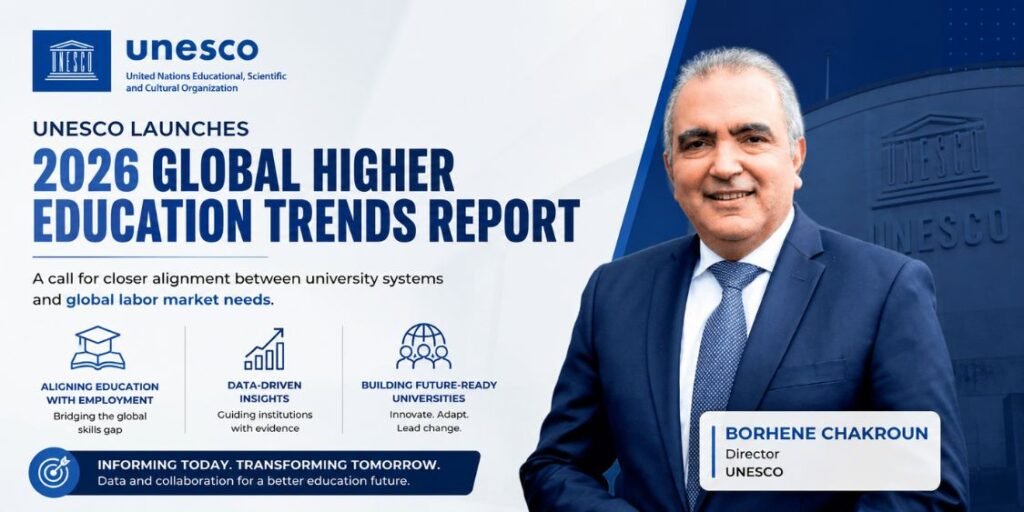
The latest UNESCO Global Education Trends 2026 report has placed global higher education systems under renewed scrutiny, with UNESCO urging universities to better align academic programs with evolving labor market demands. The report, launched under the leadership of Borhene Chakroun, emphasizes the growing disconnect between graduate skills and employer expectations worldwide.
According to UNESCO, universities must rapidly modernize curriculum structures, integrate data-driven learning models, and strengthen collaboration with industries to prepare students for future economies. The report warns that without immediate reforms, millions of graduates could face widening employment challenges in an increasingly technology-driven world.
Why UNESCO Global Education Trends 2026 Is Trending
The UNESCO Global Education Trends 2026 report has become a major discussion point among policymakers, universities, and education technology leaders because it directly addresses the global skills gap crisis.
Higher education institutions across multiple countries are struggling to keep pace with fast-changing workforce requirements in areas such as artificial intelligence, digital transformation, sustainability, and advanced technical skills. UNESCO’s findings suggest that traditional academic systems are no longer sufficient to meet modern economic realities.
Education leaders are particularly focused on the report’s recommendation for universities to adopt real-time labor market analytics and flexible learning pathways that can respond more quickly to industry shifts.
Borhene Chakroun Calls for Data-Driven University Reform
During the launch of the report, Borhene Chakroun stressed the importance of using data and innovation to reshape higher education strategies. He noted that universities must evolve beyond conventional teaching methods and embrace lifelong learning frameworks that support continuous upskilling.
The report also highlights the growing importance of partnerships between governments, private industries, and academic institutions. UNESCO believes stronger collaboration could help students transition more effectively from education into employment.
Analysts say the recommendations outlined in the report may influence future education policies, funding priorities, and curriculum standards in both developed and emerging economies.
Universities Face Pressure to Close the Global Skills Gap
One of the report’s central concerns is the widening gap between academic qualifications and practical workforce readiness. UNESCO argues that employers are increasingly prioritizing adaptable skills, digital competencies, and interdisciplinary expertise.
The organization also warned that institutions failing to innovate could face declining student relevance in a highly competitive global education market. As a result, many universities are expected to accelerate investments in digital learning ecosystems, workforce partnerships, and AI-supported education systems.
Industry experts believe the report could shape strategic planning discussions across universities throughout 2026 and beyond.
What Comes Next for Global Higher Education
The release of UNESCO Global Education Trends 2026 is expected to spark broader international conversations about the future of higher education reform. Governments and universities may now face growing pressure to redesign learning models that directly support economic resilience and workforce preparedness.
As institutions respond to UNESCO’s recommendations, education leaders will closely watch how policy changes, technology adoption, and labor market collaboration reshape the next generation of global higher education systems.
Also Read: Minouche Shafik Global Scholars Program Sparks AI Education Shift