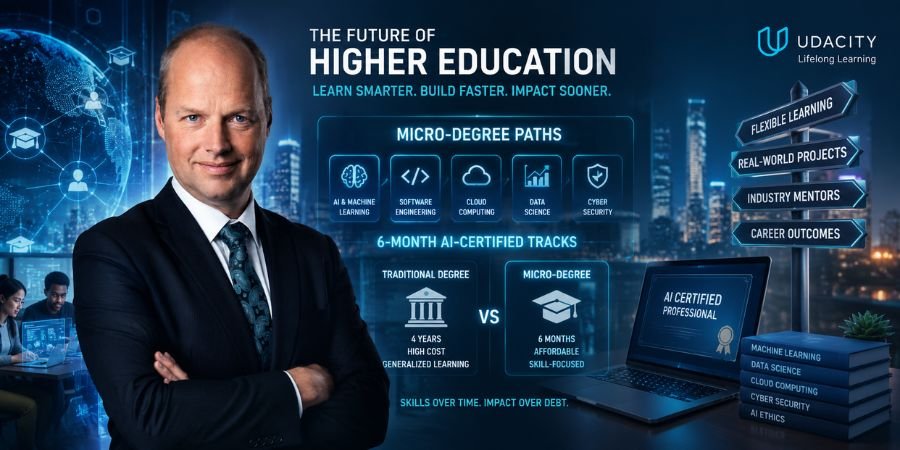
The future of higher education is under intense debate after Sebastian Thrun introduced a bold proposal centered on “Micro-Degree” pathways. The concept suggests replacing traditional four-year university degrees with focused, AI-certified six-month learning tracks designed for faster career readiness.
The idea has quickly gained traction across academic and tech communities, especially as industries demand more specialized and job-ready skills in shorter timeframes.
What Are Micro-Degrees and Why They Matter
The proposed Micro-Degree model focuses on condensed, skill-based learning programs that emphasize practical expertise over extended academic theory. These programs are designed to be completed in six months, with certification backed by artificial intelligence-driven assessment systems.
Supporters argue that Micro-Degree systems could significantly reduce education costs and time investment while increasing workforce adaptability in fast-evolving sectors like AI, data science, and software engineering.
Udacity’s Role in the Micro-Degree Movement
The discussion is closely linked to online education platforms such as Udacity, which have long pioneered “nanodegree” programs aimed at bridging the gap between academic learning and industry needs.
Thrun’s vision expands on this foundation by proposing even shorter, more targeted learning pathways that align directly with employer demands and real-world skill applications.
Rising Debate: Universities vs Fast-Track Learning Models
The Micro-Degree proposal has triggered a global debate about the relevance of traditional universities. Critics argue that replacing four-year degrees may undermine foundational learning, critical thinking development, and campus-based academic experiences.
However, supporters believe Micro-Degrees reflect the future of education, where continuous learning and rapid reskilling are essential for career survival in an AI-driven economy.
Industry Impact and Workforce Transformation
If widely adopted, Micro-Degree programs could reshape hiring practices across industries. Employers may increasingly prioritize verified skill certifications over traditional academic qualifications, especially in technology-driven roles.
This shift could also push universities to redesign curricula, integrating shorter, modular learning systems alongside conventional degree structures.
What Happens Next in the Micro-Degree Debate
As the Micro-Degree discussion continues to gain momentum, education policymakers, universities, and tech leaders are expected to evaluate hybrid learning models that combine traditional academic depth with accelerated skill-based training.
In the coming years, the outcome of this debate could significantly redefine how future generations access education and build careers in a rapidly evolving global economy.
Read Also: Ambassador Chola Milambo Opens 2026 UN STI Forum at UN Headquarters