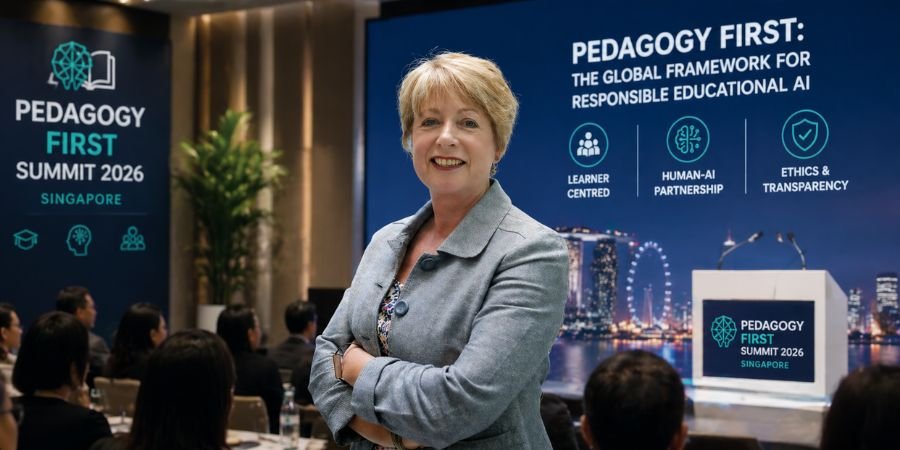
Singapore Summit Puts “Pedagogy First” at the Center of AI in Education
On April 29, Professor Rose Luckin of UCL Knowledge Lab led a major education summit in Singapore, unveiling a new certification system for artificial intelligence tools. The initiative, introduced under the rose luckin pedagogy first framework, aims to ensure AI technologies actively support human learning rather than simply generating automated answers.
The announcement marks a significant shift in how schools and institutions evaluate AI-driven tools, emphasizing pedagogy—the science of teaching—before technology adoption.
New Certification Aims to Redefine AI Use in Classrooms
At the summit, Professor Luckin introduced a structured certification model designed to assess whether AI tools genuinely enhance student learning outcomes. Unlike traditional evaluation systems focused on functionality, the rose luckin pedagogy first approach prioritizes educational value, ethical design, and measurable learning impact.
The certification is expected to guide school leaders, policymakers, and edtech developers in selecting tools that align with evidence-based teaching practices. It also addresses growing concerns about over-reliance on AI systems that may reduce critical thinking and student engagement.
Why the Framework Is Gaining Global Attention
The timing of this announcement is critical. As educational AI transitions from early-stage hype to widespread classroom adoption, institutions worldwide are seeking reliable frameworks to separate effective tools from superficial innovations.
The rose luckin pedagogy first model is quickly emerging as a global benchmark because it provides clear, actionable criteria for evaluating AI in education. Experts believe it offers a practical solution to a pressing challenge: ensuring technology enhances, rather than replaces, the role of teachers.
Singapore’s role as the host of the summit further highlights its position as a leading hub for educational innovation and digital policy experimentation.
A Shift From Technology-First to Learning-First Thinking
For years, the integration of AI in education has been largely technology-driven. Schools often adopted tools based on novelty or efficiency, without fully understanding their impact on learning outcomes.
Professor Luckin’s framework challenges this approach by placing pedagogy at the core of decision-making. The rose luckin pedagogy first philosophy encourages educators to ask a critical question: does this tool improve how students learn, think, and apply knowledge?
This shift reflects a broader movement within global education systems to prioritize human-centered learning in an increasingly automated world.
What Comes Next for AI in Education
With the introduction of this certification, industry experts anticipate increased accountability for edtech companies and more informed decision-making by educators. The rose luckin pedagogy first framework may soon influence international standards, procurement policies, and curriculum design.
As schools continue to integrate AI into everyday teaching, frameworks like this are likely to play a defining role in shaping the future of education—where technology serves as a partner to human intelligence, not a replacement.
Also Read: Linda McMahon Visits Charter School, Sparks Buzz Nationwide