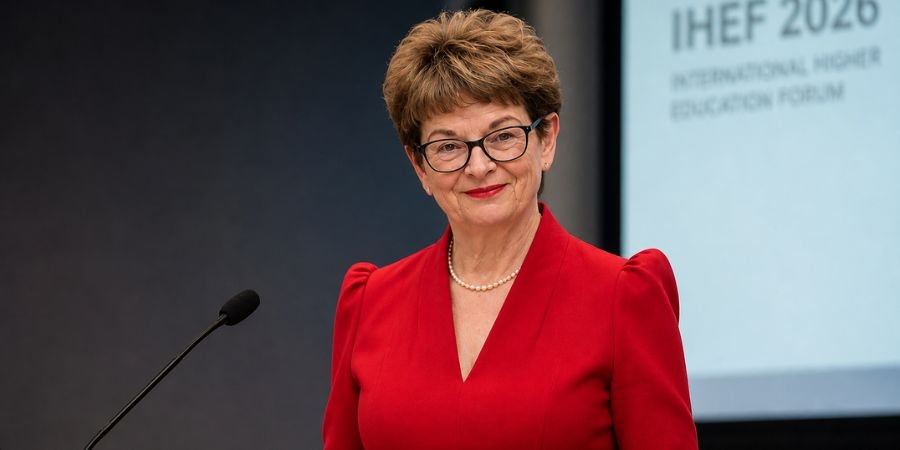
At the International Higher Education Forum 2026 held on May 5, 2026, Professor Dame Sally Mapstone issued a stark warning: Western universities must “adapt or decline” as the global center of higher education influence steadily shifts toward Asia. Her remarks, delivered during a keynote session, immediately positioned sally mapstone ihef 2026 as a defining moment in global academic discourse.
Mapstone, who leads University of St Andrews, introduced a new strategic framework called “Resilient Partnerships.” The initiative encourages Western institutions to build deeper, more balanced collaborations with Eastern universities to remain competitive in an evolving educational landscape.
A Turning Point for Global Higher Education
The sally mapstone ihef 2026 discussion reflects a broader shift in global academic power. Over the past decade, Asian institutions have expanded rapidly in research output, funding, and international influence. Countries such as China, India, and Singapore are investing heavily in innovation-driven education systems, challenging the long-standing dominance of Western universities.
Mapstone emphasized that traditional models—often rooted in Western leadership and one-directional knowledge exchange—are no longer sustainable. Instead, she urged universities to adopt more reciprocal partnerships that recognize the growing expertise and leadership of Eastern institutions.
The “Resilient Partnerships” Framework
Central to Mapstone’s message is the concept of “Resilient Partnerships.” This framework focuses on long-term collaboration, mutual benefit, and adaptability in uncertain geopolitical environments.
According to Mapstone, resilient partnerships should prioritize:
- Shared research initiatives across regions
- Equitable academic exchanges and mobility programs
- Joint innovation hubs addressing global challenges
By fostering these connections, universities can better withstand disruptions caused by political tensions, funding shifts, or technological changes.
Why Sally Mapstone IHEF 2026 Is Trending
The sally mapstone ihef 2026 address has quickly become a focal point among academic leaders worldwide. Administrators are increasingly concerned about declining international student flows, reduced public funding, and heightened geopolitical fragmentation.
Mapstone’s call to “rewrite the Western-led playbook” resonates strongly in this context. Her leadership signals a proactive shift toward collaboration rather than competition, making her remarks one of the most discussed topics at the forum.
Experts note that her framework arrives at a critical moment, as universities seek sustainable strategies to navigate global uncertainty while maintaining academic excellence.
Implications for Universities Worldwide
The implications of the sally mapstone ihef 2026 message are far-reaching. Institutions that fail to adapt may risk losing relevance in global rankings, research influence, and student attraction.
Conversely, those embracing resilient partnerships could unlock new opportunities for innovation, cross-cultural learning, and funding diversification. The shift also underscores the importance of agility in higher education leadership, as institutions must respond quickly to changing global dynamics.
As discussions from the International Higher Education Forum 2026 continue to unfold, Mapstone’s vision is likely to shape strategic decisions across universities worldwide. In the coming months, institutions will be closely watched to see whether they adopt this collaborative approach—or risk falling behind in a rapidly transforming academic landscape.
Also Read: Rose Luckin Pedagogy First Sets New Global AI Learning Standard