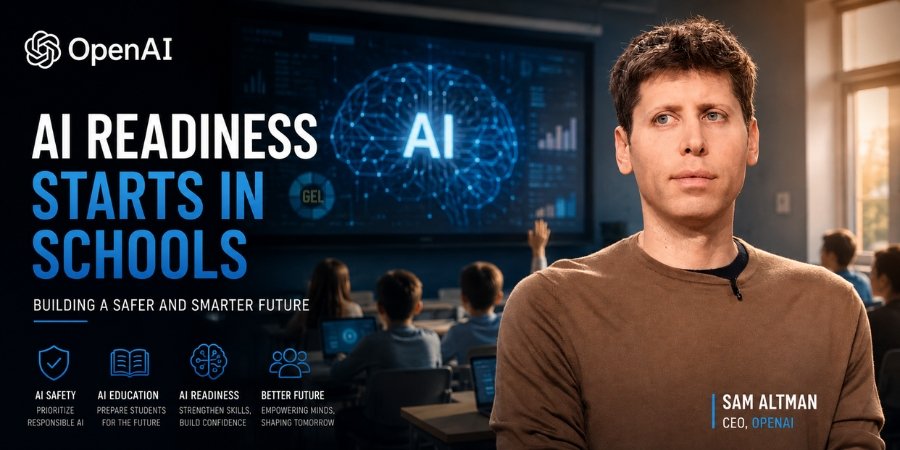
Sam Altman OpenAI CEO AI safety education 2026 became a key topic in ongoing U.S. discussions about responsible artificial intelligence as OpenAI’s chief executive outlined the importance of stronger AI safety practices and greater institutional preparedness. The conversation comes as policymakers and technology leaders continue developing voluntary frameworks to evaluate advanced AI systems before wider deployment.
Although the latest federal discussions primarily focus on cybersecurity testing for frontier AI models, education leaders are also paying close attention. Universities, schools, and research institutions are expected to play an increasingly important role in preparing students and professionals to develop and use AI responsibly while understanding its security implications.
What happened?
Sam Altman recently met with senior U.S. officials as the government finalized a voluntary review process for advanced AI models capable of performing sophisticated cybersecurity tasks. The discussions are part of broader efforts to establish practical safeguards while allowing innovation to continue at a competitive pace.
The framework encourages leading AI developers to cooperate with government agencies by voluntarily submitting powerful AI models for security evaluations before public release. These reviews are intended to identify potential cyber risks and improve resilience across critical sectors.
Why does AI safety matter for educational institutions?
Educational institutions increasingly rely on AI for research, teaching, academic support, and administrative operations. As AI systems become more capable, experts believe schools and universities should introduce structured AI governance policies that emphasize:
- Responsible AI usage by students and faculty
- Cybersecurity awareness and digital risk management
- Ethical development and deployment of AI systems
- Transparency in AI-assisted learning
- Ongoing training for educators and researchers
These measures can help institutions adopt emerging technologies while reducing potential misuse and strengthening trust in AI-enabled education.
How does this connect with U.S. AI policy?
The U.S. government has been developing voluntary safety assessments for advanced AI systems following growing concerns about models with sophisticated cybersecurity capabilities. Federal agencies have been working with major AI companies, including OpenAI, to evaluate potential risks before new frontier models reach broader deployment.
Recent policy discussions also reflect increasing attention to balancing technological innovation with national security. Officials have emphasized collaboration between government and private industry instead of imposing immediate mandatory regulations.
What could educational institutions do next?
Many experts expect universities and schools to expand AI governance initiatives over the coming years. Possible priorities include:
- Developing AI literacy programs for students.
- Updating cybersecurity curricula to address AI-enabled threats.
- Creating institutional policies for responsible AI use.
- Supporting interdisciplinary AI ethics research.
- Collaborating with industry partners on AI safety education.
Such efforts could help prepare graduates for a workforce where AI competence and responsible deployment are becoming essential skills.
What’s next?
Discussions surrounding Sam Altman OpenAI CEO AI safety education 2026 are expected to continue as governments refine AI oversight frameworks and educational institutions adapt to rapidly evolving technology. Future policy updates may further define how advanced AI models are evaluated and how schools, universities, and research organizations contribute to building a safer AI ecosystem.