Dr. Sugata Mitra Unveils 2026 Cloud Classroom Project
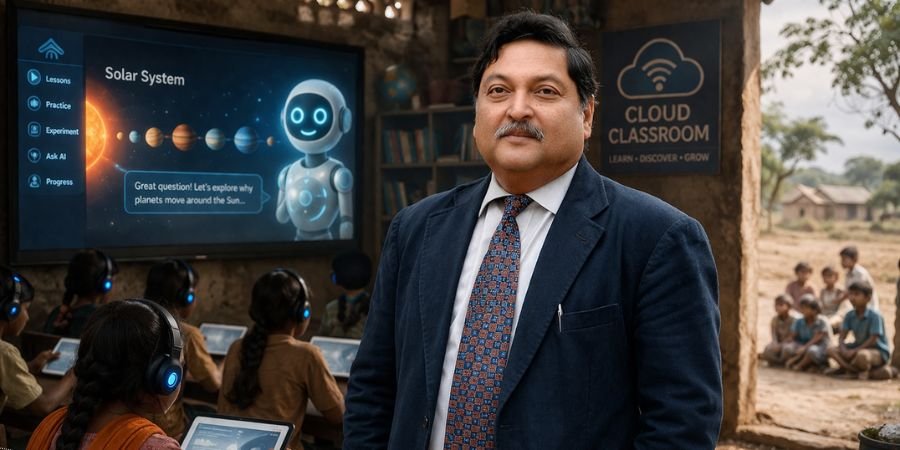
Dr. Sugata Mitra, a globally recognized educational researcher and professor, unveiled the results of his ambitious 2026 Cloud Classroom Project, demonstrating that children in remote villages can achieve high-school-level proficiency in science through self-organized learning powered by AI tutors.
The findings reveal that with minimal supervision and access to adaptive AI tools, students in underserved regions can independently grasp complex scientific concepts. This development marks a significant shift in how education can be delivered beyond traditional classroom boundaries.
AI Tutors Redefining Self-Organized Learning
At the core of the project is Mitra’s long-standing concept of self-organized learning environments (SOLEs), now enhanced with advanced AI tutors. These systems guide students through personalized learning paths, answering questions, and encouraging curiosity without the constant presence of human teachers.
The results showed measurable improvements in comprehension, retention, and application of science knowledge among participants. In some cases, students matched or exceeded the performance of their urban counterparts studying in formal school settings.
This evolution of AI-assisted education demonstrates how technology can bridge the gap between access and quality, particularly in areas where qualified teachers and infrastructure are limited.
From “Hole in the Wall” to Cloud Classrooms
Dr. Sugata Mitra first gained global attention through his “Hole in the Wall” experiment, which showed that children could teach themselves how to use computers with little guidance. The 2026 Cloud Classroom Project builds on this philosophy, integrating modern AI capabilities to expand its impact.
Educators worldwide are now revisiting Mitra’s approach as a viable model for the future of schooling, especially in regions affected by conflict, poverty, or geographic isolation. By removing the dependency on physical infrastructure, this model offers a scalable and cost-effective solution.
Why This Breakthrough Is Trending in 2026
The project is gaining global attention because it aligns with urgent educational challenges. With millions of children lacking access to quality schooling, especially in war-torn or remote areas, the ability to deliver high-level education through AI-driven platforms is seen as transformative.
Experts are calling this a turning point in global education systems. Governments, NGOs, and edtech companies are increasingly exploring how such models can be implemented at scale to ensure inclusive and equitable learning opportunities.
Moreover, the success of AI tutors in fostering independent learning raises important questions about the evolving role of teachers, classrooms, and educational policies in a digital-first world.
Implications for the Future of Schooling
The success of the 2026 Cloud Classroom Project suggests that education systems may soon shift toward hybrid or fully decentralized models. Schools could become less about physical spaces and more about facilitating access to intelligent learning ecosystems.
While challenges remain—such as digital access, content localization, and policy adoption—the potential impact is undeniable. Mitra’s work is already influencing discussions around curriculum design, teacher training, and global education reform.
As the education sector continues to adapt to rapid technological advancements, initiatives like this may redefine how knowledge is delivered and consumed across the world.