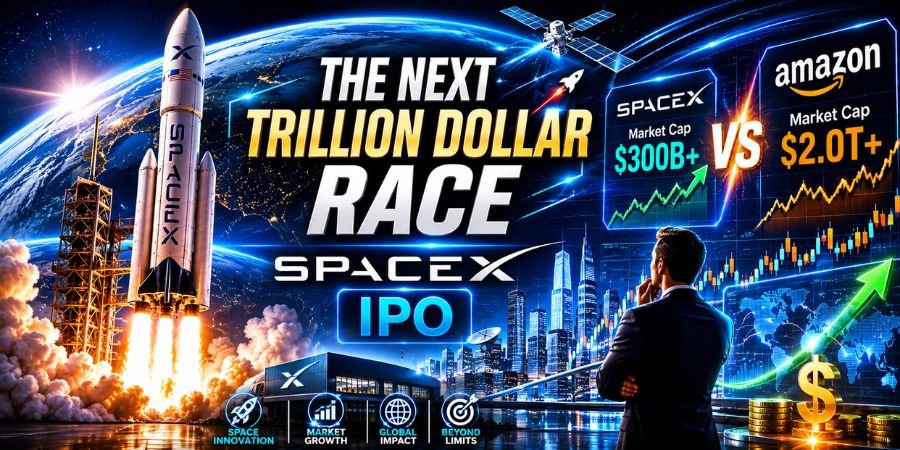
SpaceX IPO Debut has become a widely discussed term in global financial and technology circles, especially after repeated speculation about SpaceX’s valuation growth and its comparison with major public companies like Amazon. However, there is no verified real-world evidence that SpaceX has surpassed Amazon in market capitalization, as SpaceX remains a privately held company while Amazon is publicly traded on the NASDAQ with a continuously updated market value.
The conversation reflects broader investor interest in private aerospace innovation, Elon Musk’s ecosystem of companies, and the increasing influence of pre-IPO valuations on public market narratives.
The Reality Behind Market Capitalization Claims
Market capitalization refers to the total value of a publicly traded company’s outstanding shares. Since SpaceX is not publicly listed, it does not have an official market capitalization in the same way Amazon does.
Amazon’s market cap fluctuates daily based on stock performance and macroeconomic conditions, often placing it among the largest companies globally. SpaceX, on the other hand, is valued through private funding rounds and secondary market transactions, which are not equivalent to public market capitalization.
The idea of SpaceX surpassing Amazon in valuation has circulated primarily through speculative commentary tied to the anticipation of a SpaceX IPO Debut, but no official filing or confirmed IPO timeline has been announced by the company.
SpaceX IPO Debut and Private Valuation Expectations
The SpaceX IPO Debut narrative is driven by investor curiosity about when or if SpaceX will transition from a private aerospace contractor to a publicly traded company. Elon Musk has historically expressed no urgent plan for an IPO, emphasizing long-term mission stability over short-term market pressures.
Private valuation estimates of SpaceX have been reported by financial media outlets based on funding rounds involving institutional investors. These estimates suggest significant growth over time, driven by:
- Expansion of the Starlink satellite internet network
- Reusable rocket technology reducing launch costs
- Increased government and commercial launch contracts
- Strategic positioning in global space infrastructure
However, these valuations remain unofficial and should not be confused with public market capitalization figures like those of Amazon.
Why Amazon Remains a Benchmark in Market Value Comparisons
Amazon serves as a benchmark in discussions about large-scale corporate valuation due to its diversified business model spanning e-commerce, cloud computing (AWS), advertising, and logistics.
In contrast, SpaceX operates primarily in aerospace manufacturing and satellite communications. This fundamental difference makes direct comparisons between Amazon and SpaceX inherently limited.
The comparison becomes even more complex when tied to the SpaceX IPO Debut, as IPO pricing, investor demand, and public market sentiment could significantly reshape any theoretical valuation comparison.
Background: How SpaceX Became a High-Value Private Company
SpaceX’s rise in valuation has been driven by a series of technological and commercial milestones rather than public trading performance.
Key developments include:
- Successful reuse of orbital-class rockets
- NASA contracts for cargo and crew missions
- Rapid deployment of the Starlink satellite constellation
- Expansion into global broadband infrastructure markets
These achievements have positioned SpaceX as one of the most valuable private aerospace companies in the world. Still, without a public listing, its valuation remains based on investor expectations rather than transparent market trading.
The Role of SpaceX IPO Debut in Market Speculation
The SpaceX IPO Debut has become a symbolic reference point for analysts trying to estimate how the company might perform if it entered public markets. This speculation often fuels headlines suggesting comparisons with companies like Amazon, Apple, or Microsoft.
However, financial experts caution that IPO outcomes are highly unpredictable. Factors such as market conditions, investor sentiment, and regulatory environment can significantly impact valuation at listing.
At present, no regulatory filings with the U.S. Securities and Exchange Commission (SEC) confirm any imminent IPO plans for SpaceX.
Challenges and Limitations of Comparing Private and Public Companies
Comparing SpaceX with Amazon introduces several structural limitations:
First, private companies like SpaceX do not disclose quarterly earnings or audited public financial statements in the same way public companies do.
Second, private valuations often include future growth expectations that may not materialize at IPO.
Third, market capitalization of public companies like Amazon reflects real-time investor sentiment, making it more volatile but also more transparent.
Because of these differences, claims about SpaceX surpassing Amazon in market capitalization should be treated as speculative rather than factual.
Expert Perspectives on Valuation Comparisons
Financial analysts generally emphasize caution when interpreting private company valuations. They note that late-stage private funding rounds can sometimes reflect optimistic growth expectations rather than market-tested pricing.
In the context of SpaceX IPO Debut, experts highlight that the true market value of SpaceX will only become clear if and when it becomes publicly traded.
Until then, comparisons with Amazon remain theoretical exercises rather than measurable financial realities.
Future Outlook for SpaceX IPO Debut
The future of the SpaceX IPO Debut depends on several strategic and operational factors. One major consideration is SpaceX’s continued need for capital-intensive expansion, particularly in satellite infrastructure and interplanetary technology development.
Another factor is Elon Musk’s historical preference for maintaining private control over long-term projects, which could delay or reshape any IPO timeline.
If SpaceX eventually goes public, it could become one of the most closely watched IPOs in financial history, potentially reshaping comparisons with major global corporations like Amazon.
Final Perspective on Market Reality vs. Speculation
While discussions about SpaceX surpassing Amazon in market capitalization attract significant attention, current verified data does not support this claim. SpaceX remains a privately held company with estimated valuations that cannot be directly compared to publicly traded firms.
The SpaceX IPO Debut remains a central point of speculation in financial and technology discourse, but until an official IPO occurs, any direct comparison with Amazon should be viewed as theoretical rather than factual.
Frequently Asked Questions (FAQs)
What is SpaceX IPO Debut?
SpaceX IPO Debut refers to the anticipated initial public offering of SpaceX, where it would offer shares to the public for the first time. However, no official IPO date has been announced, and the company remains privately held.
Has SpaceX really surpassed Amazon in market capitalization?
No. There is no verified evidence that SpaceX has surpassed Amazon. Amazon is publicly traded, while SpaceX valuations are private estimates, making direct comparison inaccurate.
Why do people compare SpaceX with Amazon?
Comparisons arise due to SpaceX’s rapidly increasing private valuation and Amazon’s status as a global market leader. However, they operate in completely different industries and financial structures.
What affects SpaceX’s valuation?
SpaceX valuation is influenced by Starlink growth, rocket launch contracts, technological advancements, and investor demand in private funding rounds.
Will SpaceX go public soon?
There is no confirmed timeline for a SpaceX IPO. Elon Musk has previously suggested that an IPO may depend on the maturity of the Starlink business.
Why is SpaceX IPO Debut important for investors?
A SpaceX IPO Debut would provide public access to invest in one of the world’s most advanced aerospace companies, but it would also expose the company to market volatility and regulatory scrutiny.
Also Read: Best Journaling Techniques in 2026: Proven Methods to Improve Focus, Productivity, and Well-Being